
Unlocking Capacity for Growth
Grid-aware strategies that unlock land and reduce delays
What is Grid Capacity Modelling?
Grid Capacity Modelling is the process of accurately forecasting peak energy demand for new developments. Unlike blunt DNO block loading assessments, Hubb uses probabilistic modelling to reveal realistic usage patterns. This approach reduces grid connection costs and unlocks land sites previously deemed unviable due to power constraints.
Why Capacity Matters
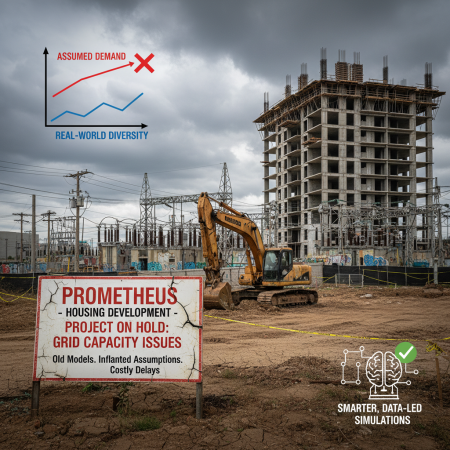
Developers face stalled projects due to grid bottlenecks, inflated ADMD assumptions, and costly over-engineered designs.
Constrained grid capacity is one of the biggest blockers to housing delivery .
Old deterministic block loading models exaggerate demand, leading to unnecessary cost .
Smarter, data-led simulations reveal real-world diversity and reduce over-specification.
Old vs. New Approaches
Traditional methods:
- Manual spreadsheets & assumptions
Over-engineered, costly infrastructure
Hubb approach:
Simulations with diverse household profiles
Data-led rapid optioneering to compare scenarios in minutes
Clear evidence base for DNO/IDNO negotiations

Tools and Capabilities
Highlight what’s live now and what’s coming:
Live: PV, battery, EV load modelling; heating system comparisons; utility phasing
Coming soon: Probabilistic simulations; scenario-based multi-run models
Outcome: Lower capacity requirements, reduced connection costs, faster POC approvals

Outcomes & Proof Points
Unlock stalled land and constrained sites
Reduce Point of Connection costs by evidencing lower peak demand
Gain competitive advantage in land bids
Improve compliance with Future Homes Standard & HEM

Capacity: Unlocking Land and Grid Potential
How can smarter capacity planning unlock land that looks unviable today?
Traditional deterministic load models often exaggerate grid demand, leading to expensive reinforcement costs. By using probabilistic simulations and data-led optioneering, developers can demonstrate realistic demand profiles. This evidence helps unlock constrained sites, turning previously “unviable” land into viable housing opportunities.
Why are Point of Connection (POC) offers so costly — and can they be reduced?
POC offers are based on assumed peak demand, which can be inflated by outdated modelling. By presenting probabilistic capacity evidence to DNOs or IDNOs, developers can often reduce required capacity, shortening cable runs, avoiding unnecessary substations, and lowering total connection costs.
What’s the difference between deterministic and probabilistic load modelling?
Deterministic modelling assumes all households behave identically, creating unrealistically high peaks. Probabilistic modelling introduces diversity by using variable occupancy profiles, heating schedules, and weather data, producing a more accurate and defendable picture of real-world grid usage.
How does capacity optimisation help meet Future Homes Standard compliance?
The Future Homes Standard demands integration of low-carbon heating, EV charging, and renewables. Capacity optimisation ensures these systems can be included without overstating demand. This reduces reinforcement costs while maintaining compliance and improving long-term energy resilience.
Can capacity modelling speed up planning approvals?
Yes. Demonstrating optimised capacity can de-risk planning conversations by showing regulators and planners that projects meet compliance without unnecessary infrastructure. This evidence-based approach improves approval rates and reduces costly redesigns later in the process.
How does capacity planning impact housing affordability?
Every pound spent on unnecessary reinforcement is a pound not invested in housing delivery. Smarter capacity planning reduces utility costs, allowing developers to deliver more units or reduce per-unit cost, directly improving affordability and viability.
What role do batteries, PV, and EVs play in capacity optimisation?
These technologies shift, store, and balance demand. Integrated modelling shows how PV generation, home batteries, and EV charging diversity reduce peak loads. This not only supports compliance but also minimises infrastructure costs by spreading demand more evenly across the day.
How do you negotiate with DNOs/IDNOs using capacity data?
Probabilistic evidence provides a stronger case than traditional block models. Developers can present scenario analyses showing average, worst-case, and likely demand outcomes. This positions negotiations around realistic requirements rather than inflated assumptions, leading to lower connection charges.
Can capacity optimisation give me an edge in land bids?
Yes. By evidencing lower infrastructure costs upfront, you can bid more competitively on land that others view as constrained. This creates a strategic advantage, particularly in regions where grid bottlenecks are limiting new housing delivery.
How does Hubb’s approach differ from standard MEP consultancy?
Traditional MEP consultancies rely on fixed assumptions and manual calculations. Hubb combines real-world datasets, probabilistic simulations, and rapid optioneering to deliver evidence-backed capacity models. This approach not only reduces cost but also strengthens compliance and regulatory engagement.